
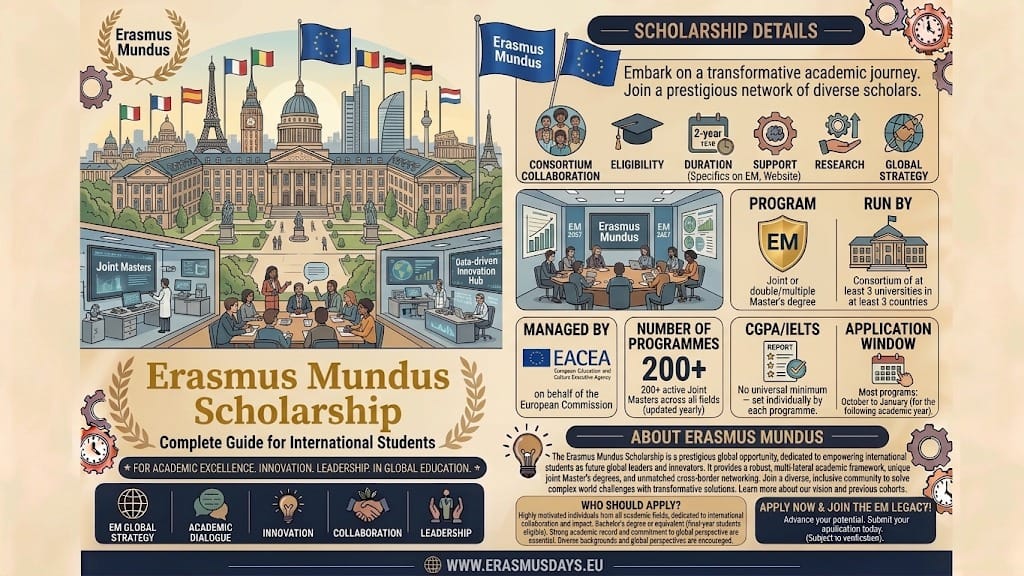
The Erasmus Mundus Scholarship funds Joint Masters — international master’s programmes designed and delivered by a consortium of higher education institutions. Students can study at several universities in different countries, and the best-ranked applicants may receive full funding.
This guide explains how Erasmus Mundus works, who can apply, what the scholarship covers, how to find a suitable program, which documents you may need, and how to submit an application.
Quick Highlights
| Category | Details |
|---|---|
| Program Type | Joint or double/multiple Master’s degree |
| Run By | Consortium of at least 3 universities in at least 3 countries |
| Managed By | EACEA (European Education and Culture Executive Agency), on behalf of the European Commission |
| Duration | 1 to 2 academic years (60, 90, or 120 ECTS) |
| Funding | Full scholarships for top-ranked applicants; covers participation costs, travel, visa, and a living allowance |
| Eligibility | Bachelor’s degree or recognised equivalent (final-year students eligible if graduating before the programme starts) |
| CGPA/IELTS Requirement | No universal minimum — set individually by each programme |
| Number of Programmes | 200+ active Joint Masters across all fields, updated yearly |
| Application Window | Most programmes: October to January (for the following academic year) |
| Where to Apply | Directly through each programme’s own official website (no single central application) |
What Is Erasmus Mundus?
Erasmus Mundus is part of the European Union’s Erasmus+ program. Its Joint Masters bring together higher education institutions from different countries to deliver an integrated master’s program.
An Erasmus Mundus Joint Master involves at least three institutions from three different countries. Depending on the programme, students may complete periods of study, research, traineeships, thesis preparation and defence at different partner institutions.
The scheme is managed on behalf of the European Commission by EACEA (the European Education and Culture Executive Agency), the EU body responsible for approving, funding, and overseeing Erasmus Mundus Joint Masters and their official course catalogue.
What Is an Erasmus Mundus Joint Master?
An Erasmus Mundus Joint Master is the degree program itself, while an Erasmus Mundus scholarship is the financial support awarded to selected students.
A programme may award either a joint degree or multiple degrees from the participating institutions. Programmes can last one to two academic years and carry 60, 90 or 120 ECTS credits.
Popular Erasmus Mundus Programmes
Erasmus Mundus currently funds 200+ Joint Master’s programmes across every field, so there is no single list that fits everyone. Here are five well-established, verified examples to show how different they can be — always confirm current details on each programme’s own official website.
MESPOM — Environmental Sciences, Policy and Management
A two-year joint Master’s covering environmental science, policy, and management. Taught across Austria, Greece, Sweden, and the United Kingdom (Central European University, University of the Aegean, Lund University, and University of Manchester). Click here for more details: Mespom
CoDaS — Communications Engineering and Data Science
A two-year programme combining communications engineering with data science, AI, and IoT. Delivered across Finland, France, Germany, Portugal, and Spain (Aalto University, Grenoble INP-UGA, TU Braunschweig, Instituto Superior Técnico, and UPC BarcelonaTech).
NOHA — International Humanitarian Action
One of the oldest Erasmus Mundus programmes (running since 1993), preparing graduates for careers in humanitarian relief and international cooperation. Delivered across France, Germany, Ireland, Malta, the Netherlands, Poland, Spain, and Sweden.
EMLE — European Master in Law and Economics
A one-year Master’s blending law and economics, letting students study at two to three partner universities. Core partners are based in Belgium, France, Germany, Italy, the Netherlands, Poland, and Spain, with additional partners outside Europe.
Mundus MAPP — Master of Arts in Public Policy
A two-year public policy degree with multiple specialisation tracks. Delivered by universities in Austria, the Netherlands, Spain, and the United Kingdom (Central European University, ISS Erasmus University Rotterdam, IBEI Barcelona, and the University of York).
To see the full, current list, always search the official EACEA Erasmus Mundus catalogue rather than relying on any third-party list, since programmes are added, renewed, or discontinued every year.
What Does the Erasmus Mundus Scholarship Cover?
Erasmus Mundus Joint Masters may offer full scholarships to the best-ranked students worldwide. According to the European Commission, scholarships cover participation costs and contribute to travel, visa expenses and a living allowance.
The exact scholarship arrangements should always be checked on the official website of the master’s programme you choose.
Who Can Apply for Erasmus Mundus?
Students from all over the world are welcome to apply. The basic academic requirement is a bachelor’s degree, or an officially recognised equivalent qualification. Students in their final year can also apply if they graduate before the master’s programme begins.
Beyond these general requirements, each master’s consortium sets its own admission criteria. This means your academic background, grades, language proficiency, work experience and other requirements must be checked against the specific programme.
Erasmus Mundus for Pakistani and Indian Students
Pakistani and Indian students can apply for Erasmus Mundus Joint Masters. There is no separate universal Erasmus Mundus application system or general academic cutoff specifically for these two countries.
Instead, applicants must meet the requirements of the individual master’s programme. Your degree, academic record, English-language proficiency and other qualifications are assessed according to that programme’s admission rules.
What CGPA Is Required for Erasmus Mundus?
There is no single CGPA requirement for all Erasmus Mundus Joint Masters.
Some programmes may set a minimum grade or GPA, while others use different academic criteria. Therefore, do not rely on a general CGPA such as 3.0, 3.5 or 70% as a universal Erasmus Mundus requirement.
Check the academic requirements published by the specific master’s programme before applying.
Detailed Article on : Erasmus Mundus MESPOM Scholarship 2027-2029 | Fully Funded Master’s
Is IELTS Required for Erasmus Mundus?
There is no single IELTS score that applies to every Erasmus Mundus programme.
English-language requirements are determined by the individual master’s consortium. A programme may require IELTS, TOEFL or another accepted test, while some programmes may allow an exemption under specific conditions.
Always check the language requirements on the official website of your selected programme.
Is Work Experience or GRE Required?
Work experience and GRE requirements are also programme-specific.
Some master’s programmes may value or require relevant professional experience, while others focus primarily on academic qualifications. Similarly, a GRE score may be required by some programmes but not others.
Never assume that a requirement listed for one Erasmus Mundus programme applies to all programmes.
How to Find Erasmus Mundus Joint Master Programmes
The first step is to find a programme that matches your academic background and career goals.
EACEA, the European Education and Culture Executive Agency, maintains the official catalogue where you can search for all currently funded Erasmus Mundus Joint Masters. After finding a program, visit its official website to check the participating universities, study structure, entry requirements, scholarship availability and application instructions.
How to Choose the Right Programme
Before starting an application, check:
- Your bachelor’s degree and subject background
- Required academic qualifications
- English-language requirements
- Participating universities and countries
- Study and mobility structure
- Scholarship availability
- Application deadline
- Career or research relevance
Choosing a programme only because it offers a scholarship can lead to an unsuccessful application. Your academic profile should make sense for the programme you select.
Where Are Erasmus Mundus Programmes Taught?
Students normally study at multiple partner institutions according to the mobility structure of their selected programme.
The European Commission requires Erasmus Mundus Joint Masters to include compulsory physical mobility. The programme must include at least two study periods in two countries, with at least one period in an EU Member State or associated country.
The exact countries, universities and semester structure vary between programmes — as shown by the five examples above, which together span Austria, Belgium, Finland, France, Germany, Greece, Ireland, Italy, Malta, the Netherlands, Poland, Portugal, Spain, Sweden, and the United Kingdom.
Documents Required for Erasmus Mundus
There is no single document list that applies to every programme. The individual master’s website specifies what applicants must submit.
Common documents may include:
- Bachelor’s degree certificate
- Academic transcripts
- CV or résumé
- Motivation letter
- Recommendation letters
- Proof of English-language proficiency
- Passport or identification document
- Academic writing sample
- Portfolio or other programme-specific documents
Read the application instructions carefully before preparing your documents.
How to Write a Strong Erasmus Mundus Motivation Letter
Your motivation letter should explain why you are applying for that particular master’s programme and why your background fits it.
Focus on your academic preparation, relevant projects or experience, career goals and the connection between the programme and your future plans. Avoid using the same generic letter for every application.
A strong letter demonstrates programme fit, rather than simply explaining that you want to study in Europe or receive funding.
How to Prepare Your Erasmus Mundus CV
Your CV should present the experience most relevant to the master’s programme.
Depending on your background, this can include:
- Education
- Research
- Projects
- Employment
- Publications
- Internships
- Technical or professional skills
- Relevant extracurricular activities
Follow the programme’s instructions if it specifies a particular CV format or length.
How to Apply for Erasmus Mundus
Step 1: Find Suitable Programmes
Search the official EACEA Erasmus Mundus catalogue and identify programmes that match your background.
Step 2: Check the Eligibility Requirements
Read the selected programme’s official admission requirements. Check your degree, grades, language requirements and any additional conditions.
Step 3: Check Scholarship Availability
Confirm that the programme offers Erasmus Mundus scholarships and review the scholarship conditions.
Step 4: Prepare Your Documents
Collect your transcripts, degree documents, CV, motivation letter, recommendations and any other required materials.
Step 5: Complete the Application
Follow the application instructions provided by the master’s consortium and complete every required section.
Step 6: Submit Before the Deadline
Submit your application through the official application system specified by the programme. Keep a copy of your application and confirmation.
Where Do You Apply for Erasmus Mundus?
There is no single application form for all Erasmus Mundus Joint Masters.
Students apply directly to the institution or consortium running their chosen programme. The European Commission advises applicants to use each master’s official website for its application procedure, entry requirements and scholarship information.
This is why you should not submit personal documents or application fees through unofficial Erasmus Mundus websites.
Erasmus Mundus Application Deadlines
Application deadlines vary by master’s programme.
The European Commission states that, in most cases, applications are submitted between October and January for courses beginning the following academic year. However, the exact deadline is determined by the individual programme.
Some programmes may have separate deadlines for scholarship consideration and admission, so always check the official programme website.
What Happens After You Apply?
The application is reviewed according to the selection procedure established by the master’s consortium.
Depending on the programme, the process may include eligibility screening, academic evaluation, shortlisting, interviews or other assessments. Scholarship selection is competitive, and the consortium makes the final selection according to its established criteria.
What Happens If You Receive the Scholarship?
If selected, you will receive information from the relevant programme about your admission and scholarship.
You then need to follow the programme’s instructions for accepting the offer, completing enrolment, arranging travel and preparing for your study period in the participating countries.
Because each consortium manages its own programme, the exact post-selection procedure can differ.
Common Erasmus Mundus Application Mistakes
Avoid these mistakes when preparing your application:
- Applying without checking the programme’s academic requirements
- Assuming there is one universal CGPA requirement
- Assuming IELTS is mandatory for every programme
- Using the same motivation letter for every application
- Ignoring programme-specific document requirements
- Missing the scholarship deadline
- Applying through an unofficial website
- Choosing a programme that does not match your academic background
The safest approach is simple: use the official EACEA Erasmus Mundus catalogue to find a programme, then follow that programme’s official website for every application requirement.
Frequently Asked Questions
Can Pakistani & Indian Students Apply for Erasmus Mundus?
Yes. Students from all over the world are welcome to apply. Pakistani & Indians applicants must meet the requirements of their selected master’s program.
What CGPA Is Required for Erasmus Mundus?
There is no universal CGPA requirement. Each master’s programme sets its own academic criteria.
Is IELTS Required for Erasmus Mundus?
Not for every program. English-language requirements vary between master’s programs.
Is Work Experience Required?
Not universally. Check the admission requirements of your chosen program.
Is GRE Required?
There is no universal GRE requirement. It depends on the specific master’s program.
Is Erasmus Mundus Fully Funded?
Some Erasmus Mundus Joint Masters offer full scholarships to selected students. These scholarships cover participation costs and contribute to travel, visa and living expenses.
Who Manages Erasmus Mundus?
EACEA (the European Education and Culture Executive Agency) manages the scheme on behalf of the European Commission, including approving program and maintaining the official catalogue.
Where Can I Find Erasmus Mundus Programs?
Use the official EACEA Erasmus Mundus course catalogue, then visit the individual program website for complete details.
When Should I Apply?
n most cases, applications are submitted between October and January for programs starting the following academic year. The exact deadline varies by program.
Erasmus Mundus Application Checklist
Before submitting your application, make sure you have:
- ☐ Chosen a suitable Erasmus Mundus Joint Master
- ☐ Checked the programme’s eligibility requirements
- ☐ Confirmed scholarship availability
- ☐ Checked academic and English-language requirements
- ☐ Prepared your degree certificate and transcripts
- ☐ Updated your CV
- ☐ Written a programme-specific motivation letter
- ☐ Arranged recommendation letters
- ☐ Prepared any additional required documents
- ☐ Checked the official application deadline
- ☐ Applied through the programme’s official application portal
- ☐ Saved your application confirmation
Official Erasmus Mundus Resources
For the most reliable information, use the European Commission’s official Erasmus+ resources, the EACEA course catalogue, and the official website of the master’s programme you intend to apply for.
Erasmus Mundus Joint Masters: Official Erasmus+ Page
Note: Programme requirements, scholarship availability and application deadlines can change. Always verify the latest information on the official programme website before submitting an application.